
Shuffling the Deck
The buzzing thrum of a low-flying drone pierced the silence of the desert morning. Earlier, we'd passed a "No Drones" sign at the entrance to Skull Valley, in Tooele County, Utah's west desert, where the historic Pony Express Road runs between the Cedar and Stansbury Mountains. I was there to photograph the famous Onaqui Mountain Herd, wild horses living on 240,000 acres managed by the Bureau of Land Management (BLM), and had confirmed in advance that drone photography wasn't permitted. The only other people in sight were three photographers on the far side of the field — none of them flying a drone.
The Onaqui were grazing quietly in the early morning sun. We'd hiked half a mile from the road and had been waiting over an hour for some action — stallions sparring, yearlings giving chase. Mostly the horses dozed, grazed, and groomed each other. "It was windy last night, and they're generally restless on windy nights," our guide, Brian Clopp, of Winning Shots Photography, said. "There won't be much action until they start moving to water." Action, Brian explained, typically began when the horses "shuffled the deck": a young stallion would wander too close to another stallion's family, and the challenge was on. Ears pinned, the dominant stallion might chase off the offender, but often the two would rear up, striking with their hooves and biting at each other's necks. Other members of the herd sometimes stepped in as referees to break up the duel and restore peace. These skirmishes continued as the horses moved around, until they eventually headed for water on the other side of the hills. It had been quiet, until now.
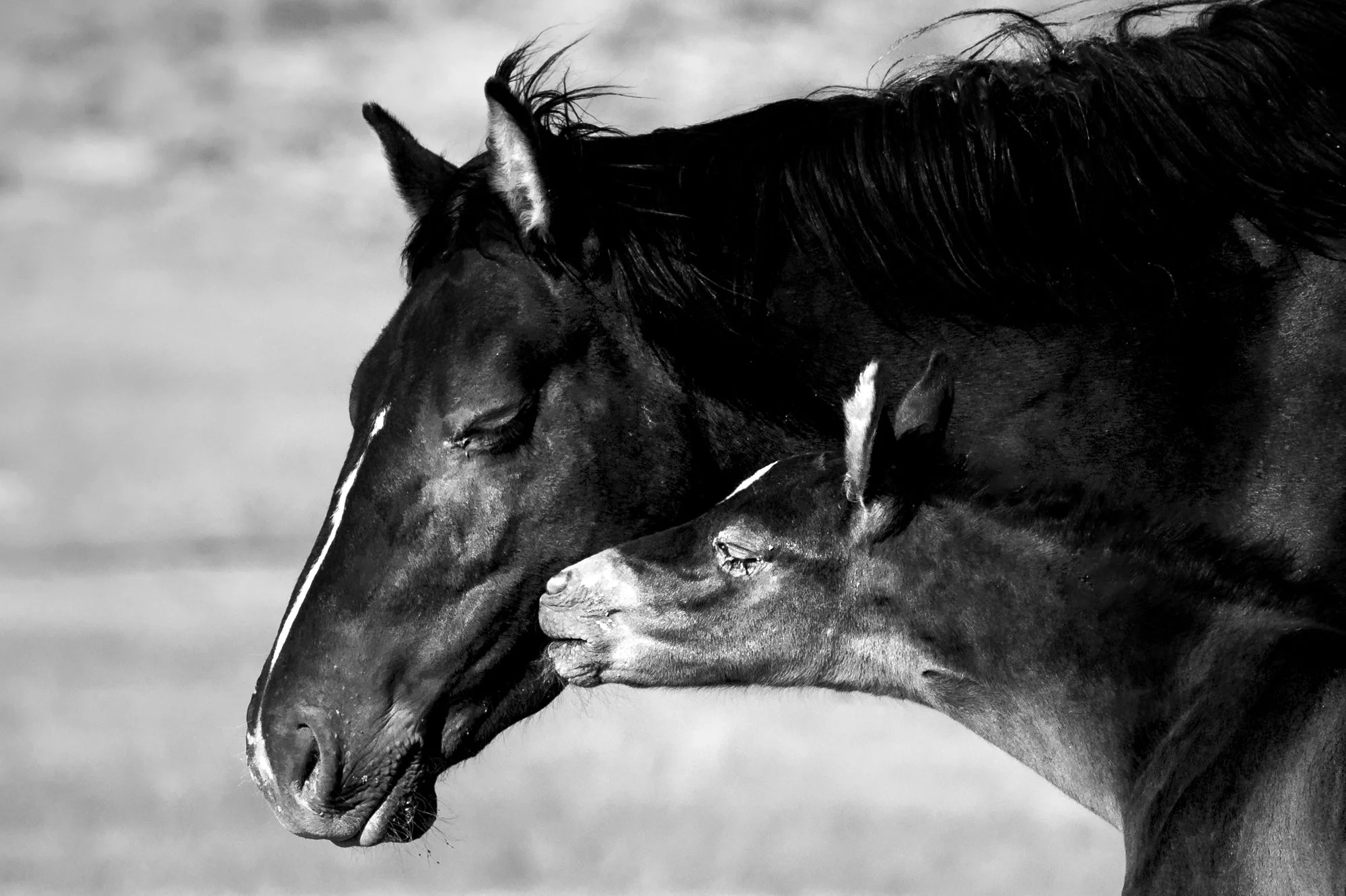
“Kisses”, Onaqui Mare and Foal, June 2026
The drone whirred low overhead, heading straight for the herd. In an instant, over 150 horses spun in near unison and took off in a thunderous stampede toward the mountain pass in the distance. "They're terrified of drones," Brian said. "Who the hell is flying it?" Whoever it was didn't seem to care as the unnerved horses galloped into the hills. The drone followed them, paused when they disappeared into the pass, then turned sharply and flew back toward the road, where a previously unnoticed pickup truck was parked. We watched helplessly as the driver retrieved the drone and sped off.
"The horses are still traumatized from the 2021 gather," Brian said. Gathers — commonly known as round-ups — occur when herd size exceeds the Appropriate Management Level (AML) for a Herd Management Area (HMA). According to the BLM, the AML for the Onaqui ranges from 121 to 210 individuals. In 2021, when the Onaqui numbered over 500, the BLM contracted Samson Livestock to round up most of the herd by helicopter, driving the horses into a trap where they were captured and trailered to holding pens. "Are they adopted?" I asked Brian. Over my years of endurance riding, I'd met several riders who had adopted and trained wild mustangs for the sport. "BLM representatives told me that 1% are adopted," he replied. My heart sank.
In 2021, 435 Onaqui horses were gathered: 312 were permanently removed from the range, and 123 were released back to the herd. The 123 released were mares treated with PZP — a contraceptive used to regulate reproduction — and stallions chosen to protect the herd's genetic diversity. Partnerships between the BLM and organizations like the Wild Horses of America Foundation now aim to regulate reproduction and minimize the need for future gathers. PZP effectively manages numbers while preserving natural horse behavior.
While this method seems to be working for the Onaqui, many other herds are still gathered: 14,000 are scheduled for round-up this year to be added to the 67,000 that were in holding at the end of 2024.
I couldn't wrap my mind around taking wild animals from their homes and ultimately spending years or the remainder of their lives in off-range holding, so I looked into the justification and economics behind it. Much of the public land the BLM manages carries established grazing rights for cattle and sheep ranchers. The BLM allows up to 2,600 cattle AUMs (Animal Unit Months) on the Onaqui range between November and April, and thousands of sheep also pass through the transit corridor along the Pony Express Road. Horses, cattle, and sheep compete for some of the same forage and water resources, so ranchers see the horses as competitors. Ranchers pay $1.69 per cow (with or without a calf) per month to graze on BLM land, for up to six months — about $8.00 per cow over the full season. It seemed the round-ups must be driven by money from the ranchers.
But the cost of round-ups and the upkeep of horses in holding pens far outweighs the income from grazing fees. A single helicopter round-up costs hundreds of thousands of dollars, and this does not include veterinary care, temporary holding, and transport to the pens. In fact, publicly available contracts between private owners and the BLM have shown that private livestock operators have earned millions of dollars for helicopter round-ups, short term holding corrals and long term holding pastures. In the past five years, $36.7 million has been spent on round-ups, including over $6 million paid to helicopter contractors in 2022 alone. In a November 12, 2024 press release, BLM specifically said there were “67,000 wild horses and burros currently in short- and long-term holding.” BLM estimated lifetime care for an unplaced animal at about $15,000, putting the future taxpayer liability for those 67,000 animals at more than $1 billion and all at the behest of domestic grazing animals.
It's consistently argued that there isn't enough forage for the horses, and that they'd starve without this kind of management. But soon after the round-ups, cattle and sheep are turned out to graze on the very land supposedly unable to sustain the horses.
Remote-dart fertility control, as currently used on the Onaqui, is a pragmatic and more cost effective answer to wild horse management. I asked Brian why the BLM hasn't transitioned from traumatic, expensive gathers to fertility control instead. "The history of cattle ranchers versus wild horses is long," he said. "The cattle ranching industry has one of the biggest, strongest lobbies in Washington, and there's a lot of money behind it." Implementation also takes time: it means changing long-established processes, and unlike a round-up, it doesn't reduce herd numbers immediately. It requires ongoing maintenance, diligent cataloging, training, and new systems.
There's some hope on the horizon. The Commerce, Justice, Science; Energy and Water Development; and Interior and Environment Appropriations Act (Public Law 119-74), signed by President Trump on January 23, 2026, maintained up to $11 million for reversible immunocontraceptive fertility control to help sustainably manage wild horse and burro populations. The legislation also urges the BLM to consider relocating wild horses and burros to different Herd Management Areas as an alternative to removal — though it stops short of mandating fertility control or relocation.
The Wild Horse and Burro Protection Act (H.R. 4356), introduced in July 2025 by Representative Dina Titus (D-NV), would ban the use of helicopters in BLM round-ups and require the Government Accountability Office to study more humane alternatives. The bill has been referred to the House Committee on Natural Resources, but no action has been taken at the time of this writing.
In April 2026, Congresswoman Nancy Mace filed an amendment to the Farm Bill incorporating key provisions of her Veterans for Mustangs Act. It directs the Secretary of Agriculture to use humane, non-surgical fertility control vaccines on Forest Service lands, prioritizing the recruitment and certification of military veterans as applicators, with compensation for those who complete training. The Forest Service would also be authorized to contract directly with certified veteran applicators to carry out this work.
As the wheels of progress turn slowly, large helicopter gathers continue across the West in 2026, with more than 14,000 horses scheduled for removal this year. For now, though, the Onaqui are stable, and the current fertility-control program is intended to reduce the need for future gathers.
By evening, the horses have come down from the mountains to water. There's action everywhere we look — a photograph in the making at every turn. Bonded pairs splash in a muddy watering hole, stallions shuffle the deck and spar for dominance, mares nurse their foals, and yearlings chase each other through the scrubby brush. The drone incident is now a distant memory; the herd once again seems secure. As golden hour approached and the sun began to set, we watched the herd move toward the horizon, their silhouettes floating like black ghosts against the blazing sky. My emotions ran high. I thought of all the members this herd had lost just a few years ago — families separated, magnificent animals that have roamed our soil for hundreds of years stolen in an instant from the only life they'd ever known. May their souls run free in the dusty desert sunset, among the herd, forever.
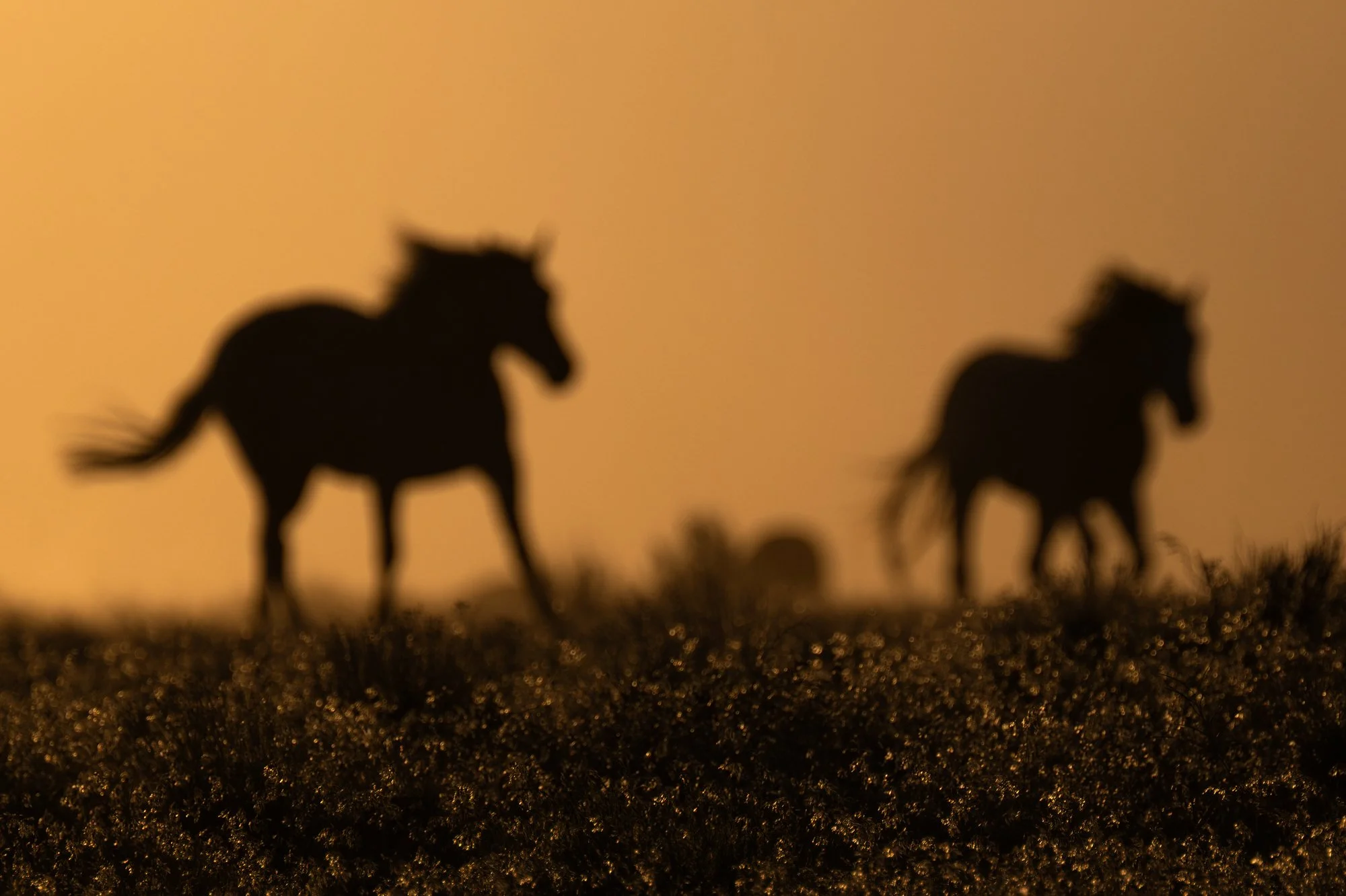
“Ghosts”, Onaqui Wild Horses at Sunset, June 2026
My photo collection of the Onaqui herd is a tribute to the wild horses that have lost their freedom in round-ups. A portion of the proceeds from the Onaqui Wild Horse Collection will be donated to organizations fighting to end helicopter round-ups once and for all.
What you can do: Write to your representatives on the House Committee on Natural Resources. Ask them to support H.R. 4356 — the Wild Horse and Burro Protection Act of 2025 — to make fertility control the new standard and helicopter round-ups a thing of the past.
Click here to send a letter:americanwildhorse.org/get-involved/action-center
Contact your representative on the House Committee on Natural Resources:congress.gov/bill/119th-congress/house-bill/4356/committee
Resources
Fertility Control: Humane Management of Wild Horses
Rep. Nancy Mace Amendment Creates Veteran Opportunities Managing Wild Horses
BLM: Onaqui Mountain Herd Management Area
Wild Horses of America Foundation: Onaqui