
Operation I.CARE
Photography courtesy of my dive buddy, Kurt Tidd
The rising sun crested the horizon as the elite special operators lined up on the deck of the 42-foot Newton, ready to plunge into the Atlantic. These Navy SEALs, Marine Recon, Air Force Pararescue, and UK Royal Marine Commandos, all veterans of Iraq, Afghanistan and beyond, had a new mission. Now members of FORCE BLUE, trained as special operations divers and uniquely mission-driven, they hit the water in scuba gear armed with hammers, mallets, post drivers, rebar, cinderblocks, sand screws, anchor bolts, monofilament cabling and PVC pipe. Their high-stakes goal was to build new coral and sponge nurseries along the Florida Keys reef tract.
The world's coral reefs are in peril, nowhere more so than in Florida. The state's 350-mile reef, the third largest on Earth, has lost 90% of its healthy coral cover since the late 1970s, according to NOAA estimates cited by NASA's Earth Observatory. Run-off, poor water quality, climate change, boating, fishing and trash have pushed this sensitive ecosystem toward extinction. Reefs shelter thousands of species, including fish, marine mammals, sea turtles, crustaceans and sharks. They feed people, produce oxygen, store carbon and shield our shores from storm surge. In many parts of the world, losing the reef has cost families their livelihoods. In the Keys, it is only a matter of time before everyone who lives or vacations there feels the loss.
Coral may look like rock, but it is an animal, and it depends on a partner. Tiny algae called zooxanthellae live inside its tissue and turn sunlight into food, fueling much of its growth and giving it color. When heat or poor water quality stresses the coral, it pushes the algae out. The coral turns white, a process known as coral bleaching. A bleached coral is starving, and without relief it can die.
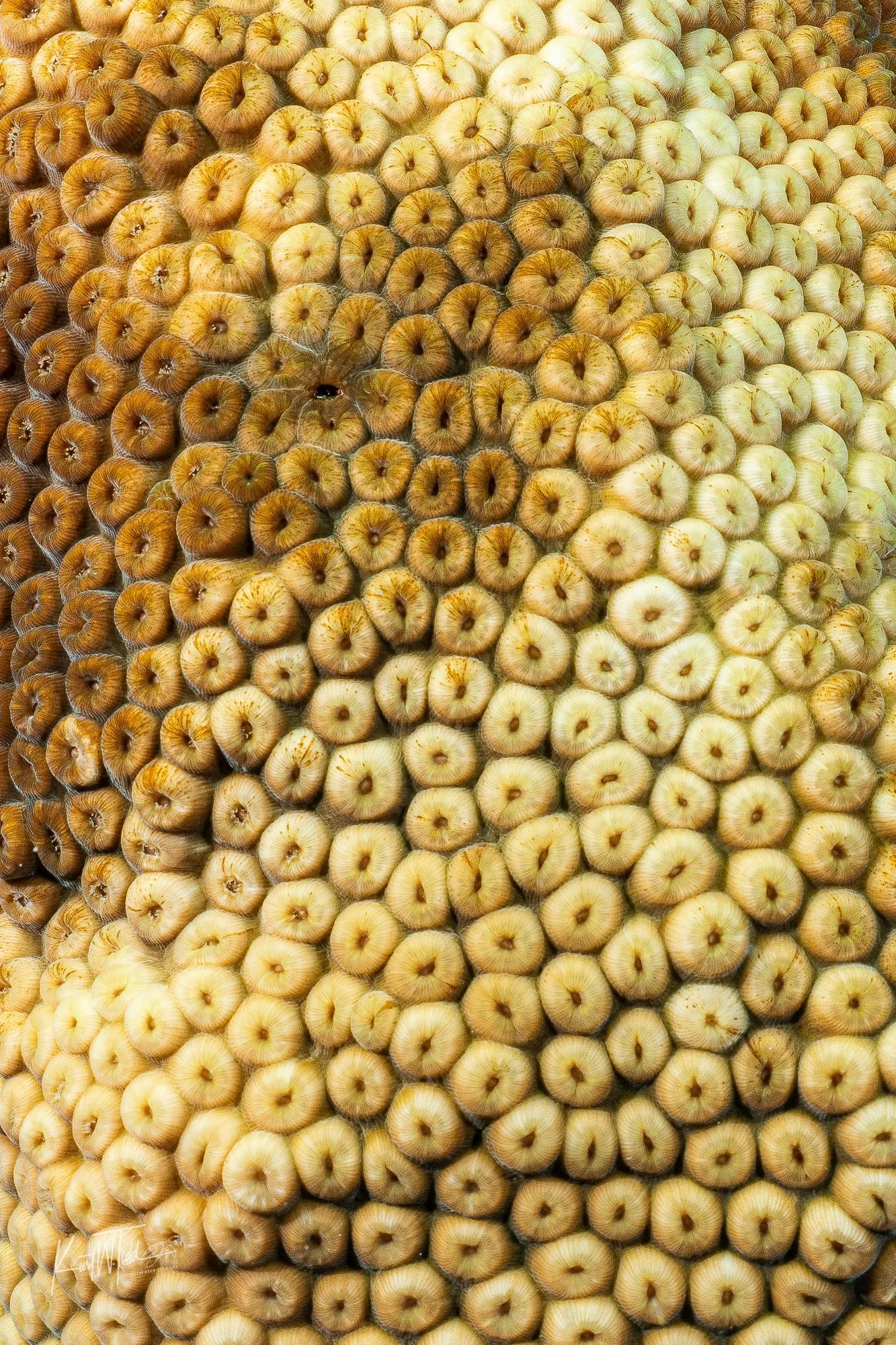
A section of bleached polyps of a dying coral
"The coral reef is the most biodiverse ecosystem on our planet. What happens to our planet without it? We've never not had it," says Mike Goldberg, owner of Key Dives in Islamorada, 2024 Top Ten CNN Hero and co-founder of the Islamorada Conservation and Restoration Education Foundation (I.CARE). "We tamper with our own existence when we lose these things."
Goldberg and co-founder Kylie Smith met in 2017, when Smith chose Key Dives to support her research. Over the next year and a half, their conversations about the reef turned into I.CARE, an organization built to bring everyday divers and the wider community into the work of restoring it. Volunteer recreational divers now work beside scientists to plant and tend corals and sponges, while those who don't dive pitch in on shore with coral husbandry, education and outreach.
Since launching in 2021, I.CARE has transplanted more than 32,000 corals and 3,700 sponges, with one-year survival rates of 53.62% and 62.62%, respectively. That success takes work. Transplants must be done correctly and monitored regularly for the same stresses the reef faces daily. Some threats can be mitigated, such as the careful removal of fireworms and corallivorous snails that feast on young coral buds, but warming seas, hurricanes and ocean acidification are much more challenging. Once a coral larvae settles on the reef, it takes most corals over 10 years before they spawn. Through a process called coral microfragmentation, that time can be cut in half. Many of I.CARE's transplants are now old enough to reproduce, which is the goal for ultimate success.
"What we are doing will work should these corals live to the point that they are spawning. This upcoming year we plan to document and hopefully capture on video our corals spawning and that is how we rebuild the reef," Goldberg says.
Rebuilding also means more nurseries. Although many corals raised in land-based laboratories survive transplant, growing them near the parent reef improves their odds. They experience the same light, salinity and temperature, avoid the shock of transport and, according to Coral Digest, can cross-breed with the parent colonies, which strengthens genetic diversity. But the nurseries must be built, and there is no time to lose.
Enter FORCE BLUE.
Founded in 2016, a year before Goldberg and Smith met, FORCE BLUE set out to address two "seemingly unrelated problems—the rapidly declining health of our planet's marine resources and the difficulty returning combat veterans have in adjusting to civilian life". Its divers are Special Operations veterans who learn marine science from leading scientists and conservationists, then take that training on missions around the world. This time, the mission was a coral and sponge nursery in the Keys, in partnership with I.CARE.
"Layering scientific diving principles on top of highly skilled and experienced military-trained divers produces a talented, mission-focused work force able to partner with the I.CARE scientific expert interns," says retired Navy Admiral Kurt Tidd, an I.CARE board member, Keys resident, avid diver and the mission's photographer. "They are force multipliers. They just get after it, and teaming two or three FORCE BLUE divers with one I.CARE intern allowed more work to be accomplished simultaneously."
Get after it they did. Descending to 40 feet, some teams removed their fins and walked the sandy bottom carrying cinderblocks for the sponge nurseries. Others swam alongside with monofilament cabling and rebar, driving it into the hardpan or deep sand with mallets to build a framework for anchoring the blocks to the sea floor.
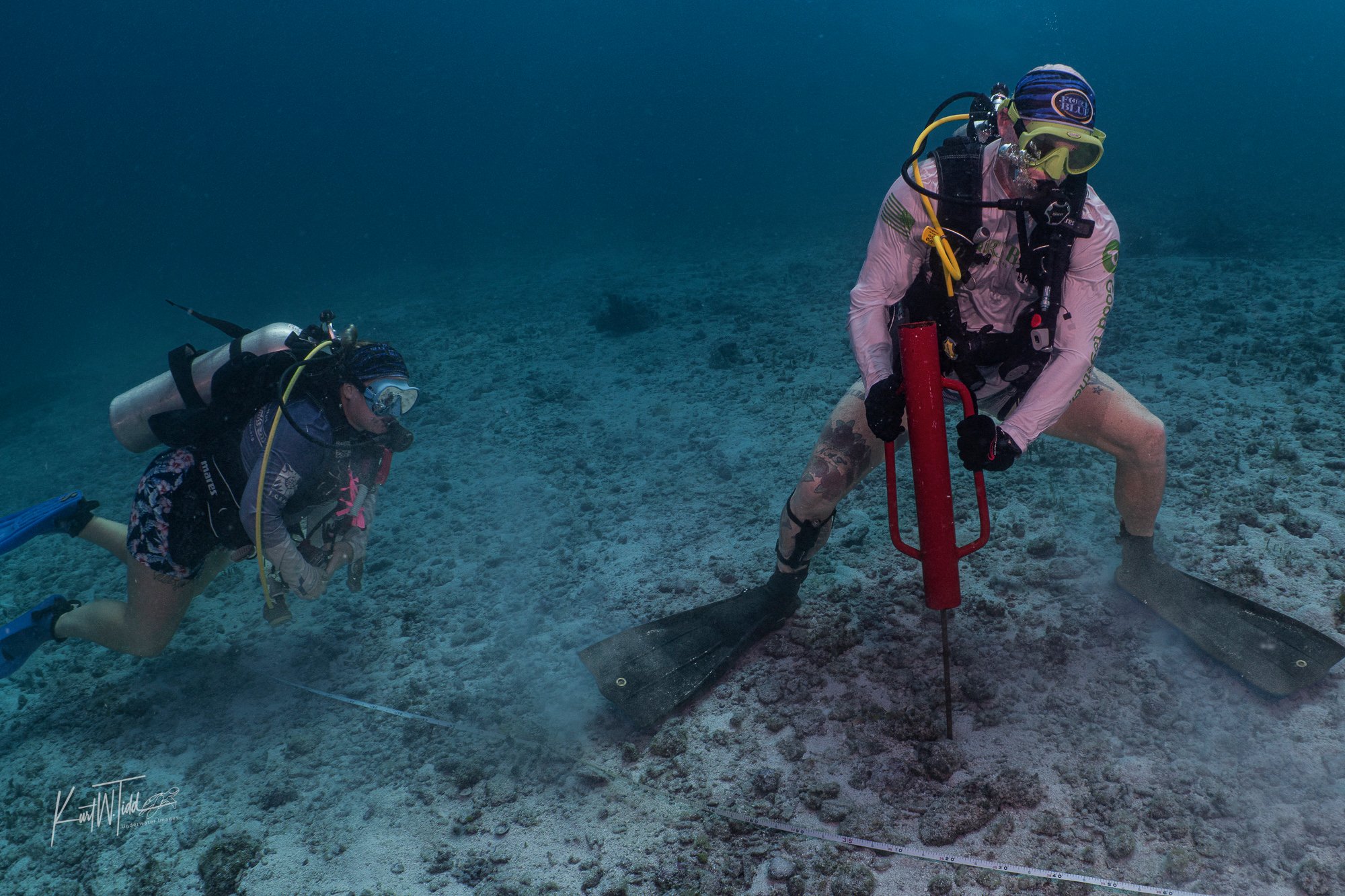
A FORCE BLUE veteran drives rebar into the hardpan
With strength, precision and the expert coordination of the I.CARE interns, the special operators secured the cinderblocks in a grid pattern. Sponge fragments collected from the nearby reef were then affixed with zip ties to 4-inch PVC pipe pieces cemented to the cinderblocks, their temporary homes.
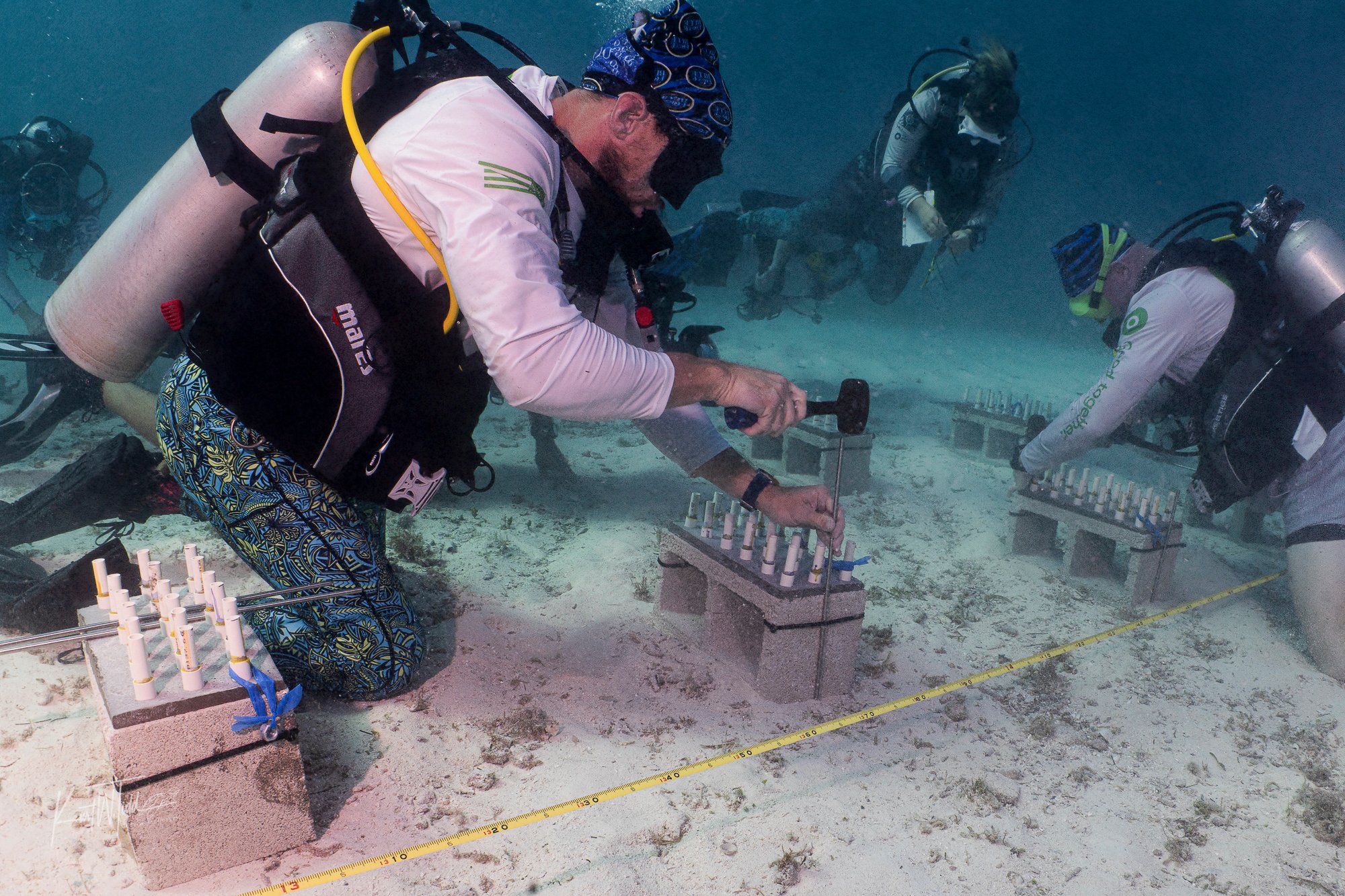
FORCE BLUE veterans place cinderblock sponge nurseries
Other teams built coral nursery "trees." They fitted a shaft of rebar through the eye bolt of each 4-foot sand screw and turned it into the sand until only the ring remained above the surface. Monofilament cabling attached to a flexible "duckbill" sand anchor was then driven into the sand with rebar and hammers.
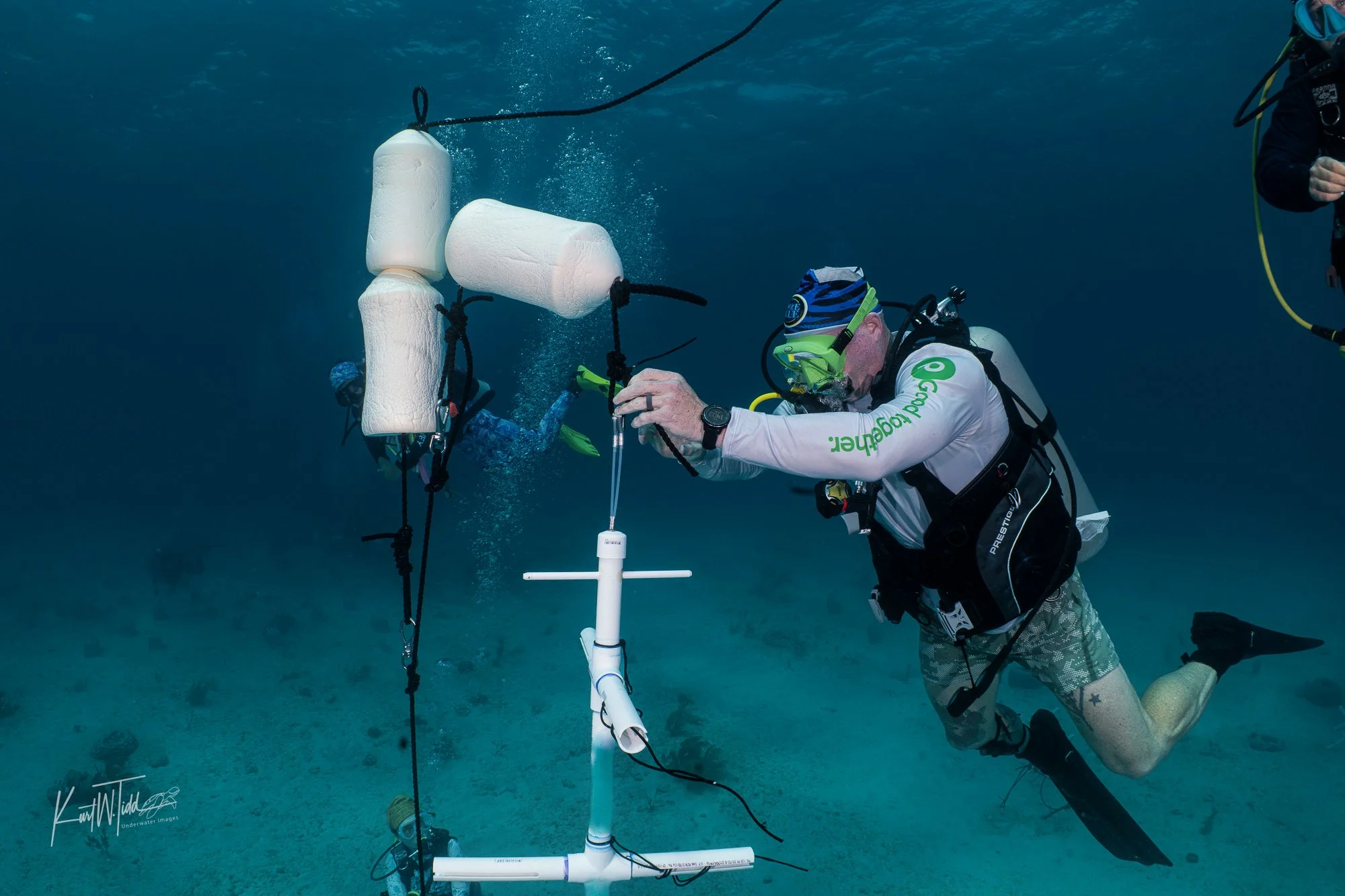
Nylon rope, tied to the sand screw and the duckbill anchors, was threaded through a PVC coral "tree" and attached to a float suspended about 10 feet below the surface. The young corals will begin their journey on these trees until they are large enough to be transplanted to the parent reef.
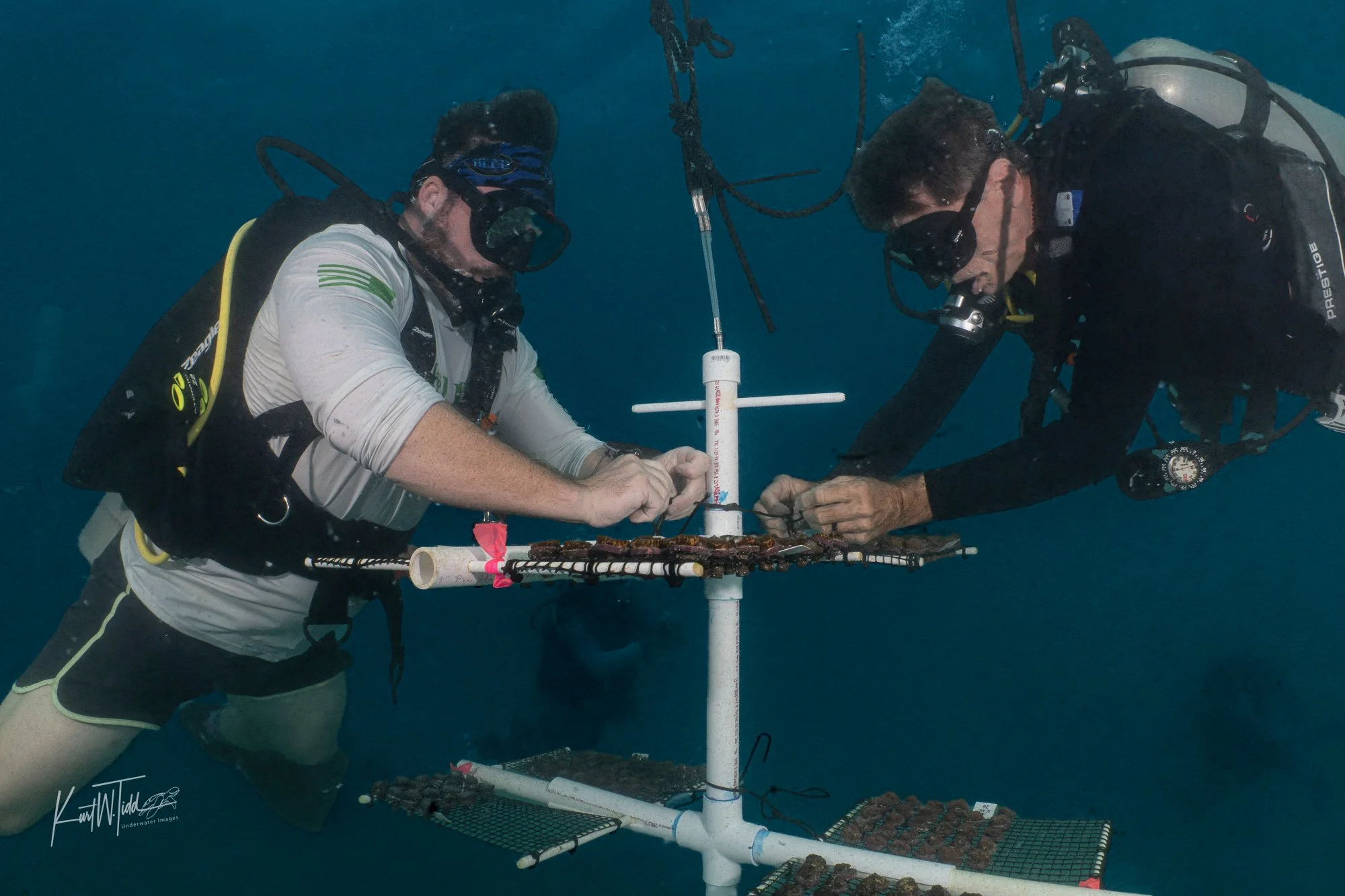
Mike Goldberg and a veteran attach juvenile coral trays to the nursery tree.
Securing the sand screws and cinderblocks was a priority, because it keeps storms and strong currents from carrying the nurseries away from the reef.
Over five days, the divers and scientists completed four sponge nurseries and three coral nurseries in sixteen 45-minute dives, hammering, tying, securing and suspending until the work was done.
Now they wait: for the juveniles to grow, the adults to spawn, the reef to recover and the funding to continue. Both I.CARE and FORCE BLUE are 501(c)(3) non-profits, and their work depends on private donations, sponsorships and government grants.
For a while, things were looking up. In 2023, Governor Ron DeSantis launched the Florida Coral Reef Restoration and Recovery Initiative (FCR3), recognizing the reef's importance to the state's waters and economy. The state has since given $28.5 million to 14 organizations, according to the Florida Trib. "Safeguarding our coral reef is important both environmentally and economically and we will continue to support projects that keep this natural resource healthy," DeSantis said in a 2024 press release. Through FCR3, I.CARE received more than $550,000, which supported two full-time salaried positions, paid for nursery materials and funded training for locals in transplanting and outreach. This year, as part of a larger budget reduction, the state reversed course and cut that funding to zero, the Trib reported.
"100% of the businesses in the Keys would be affected by the loss of the reef," Goldberg says. "It is the common thread of existence in the Keys, whether you are a real estate developer, plumber, car salesman, hotel owner or physician. We depend on people being here, and we are here because of what the ocean offers us. Without it there is no reason to be here. You can go to a lot of places where the weather is great, but without the reef, there's no fishing, diving or boating destination here. The success of everything in the Keys emanates from the coral reef."
The mission is complete. The divers answered the call. The reef is now waiting for the rest of us.
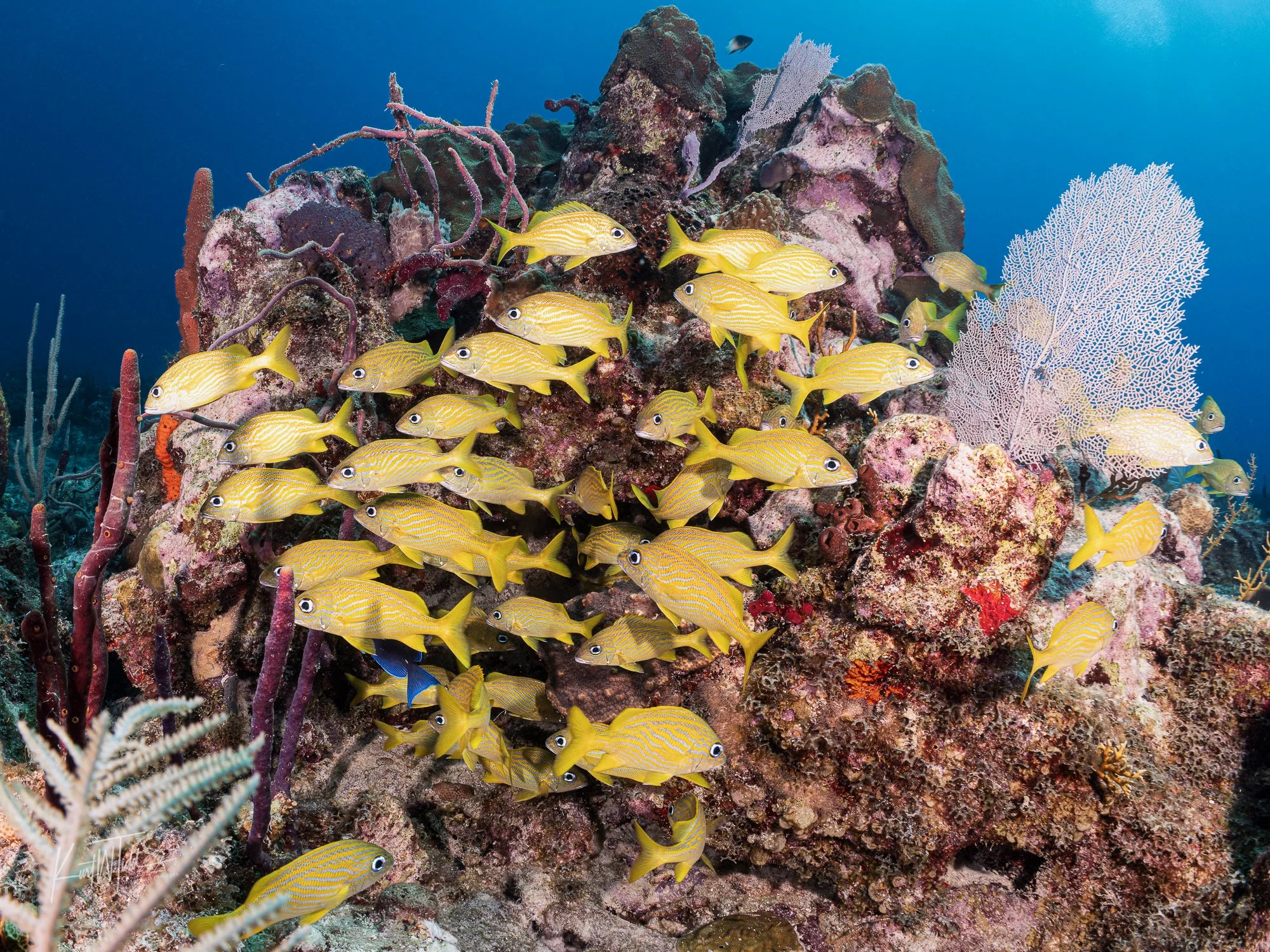
A beautiful little piece of healthy reef
Want to help? Purchase any of my photos from my REEF and MYSTERIES categories and a portion of the proceeds of the sales are donated to I.CARE. The more you spend, the more they receive.
For those wondering why I did not photograph this event myself, FORCE BLUE specific events are exclusive for the work of the veterans, the I.CARE team, and the Key Dives staff. My dive buddy is a board member of I.CARE and one of Key Dive’s resident photographers.
Sources
I.CARE. "Coral." icareaboutcoral.org/coral
I.CARE. "Our Story." icareaboutcoral.org/our-story
I.CARE. Home page (restoration statistics). icareaboutcoral.org
NASA Earth Observatory. "Confronting Florida's Coral Collapse." science.nasa.gov
Coral Digest. "Nursery Areas." coraldigest.org
FORCE BLUE. "How We Work." forceblueteam.org
Florida Trib. "DeSantis Pledged Millions for Restoring Reef, Then Pulled the Rug from Under Us." Sept. 4, 2026. floridatrib.org
Florida Department of Environmental Protection. "Coral Protection and Restoration." floridadep.gov